Our story
Gamelan Naga Mas are a community group based in Glasgow, Scotland. We are custodians of ‘Spirit of Hope’, an orchestra of Central Javanese gamelan instruments. We have been active since 1980, both performing both traditional repertoire and new and original music that we have created.
In 2017 the group took part in the Festival of Gamelan and the Moving Image at the Royal Conservatoire of Scotland, performing an original work for gamelan and live video Sedna, the Woman Under the Sea. The centrepiece of the festival was a performance of Garin Nugroho’s film Setan Jawa accompanied by live music composed by Rahayu Supanggah, that in turn prominently featured the highly distinctive work of pesindhen (singer) Peni Candra Rini.
As well as being a virtuoso singer, Peni Candra Rini is one of the foremost composers and creative performers of contemporary gamelan music working in Indonesia today. As part of the festival, Gamelan Naga Mas were fortunate to be able to perform together with Peni in a workshop setting. Since that time, it has been our joint hope that we would be able to work together again.
Fast forward to March 2020: the Covid-19 pandemic makes it impossible for musicians all over the world to continue to play together as before, Naga Mas included. Undaunted, we began to explore innovative ways in which we could use the internet to continue to play together online, including by means of collaborative ‘livecoding’ (see below).
By December 2020 we had succesfully completed a number of online performances, and realised that the techniques we were using offered the possibility of collaboration with artists based in Indonesia. We were aware of the work of composer and digital artist Rangga Purnama Aji in the field of livecoding, including working with sounds and gestures drawn from traditional gamelan music. We therefore approached both artists and established the collaborative working arrangement that has become the Floating Gold project.
Our philosophy
Synchronicity and improvisation
Music is an artform that thrives on synchronous, live performance. While it can be scored and/or recorded, it is our collective belief that, at root, music is what happens when musicians play together. This is when music is at it’s most spontaneous and creative: in the moment of performance, or better even, in the free flight of improvisation.
The Covid-19 pandemic has put great constraints on live music everywhere. Despite the many wonderful and creative video performances that have appeared online during this period, it must be realised that in the majority of cases these have been edited together from individual performances. From the perspective of the musicians, these asynchronous ‘performances’ do not truly represent the fundamental joy of playing together in real time.
A post-travel world?
There are two reasons for us to rethink our approach to travel. The pandemic is of course one of them, yet it would seem pessimistic to think that travel between Scotland and Indonesia will continue to remain problematic for this reason.
Climate change is a more fundamental challenge. A round-trip flight from Scotland to Indonesia generates around 2370kg of CO2, more than most people produce in a year. This cost may still be worth it on occasion, and can be offset in a variety of ways. Nevertheless, as artists we fell a responsibility to seek new ways to collaborate internationally.
Streaming and livecoding
We are currently exploring two approaches to synchronous online performance between Indonesian and Scotland. Commercial video conferencing tools such as Zoom afford the possibility of exchanging reasonable quality audio over the internet. There are, however, significant hurdles: all parties need reliable internet connections, fast computers, and, for the best results, dedicated audio equipment of a professional standard at both ends.
A more fundamental limitation from the perspective of musical performance is latency: the delay between making a sound at one end and hearing it at the other. Even under the best imaginable conditions, limitations imposed both by the internet and the speed of light mean that delays of at least a quarter of a second in each direction are unavoidable. While certain kinds of musical performance are still practicable, it is fundamentally impossible for musicians to truly play in time together under these circumstances.
The second approach we have been using is collaborative livecoding using the Estuary platform. In brief, this allows us to produce music by simultaneously editing computer code in a webpage, that in turn is used to create music that plays in time for each individual no matter where in the world they are located. As far as we are aware, we are the only collective of artists who are using this technique in the context of contemporary music for gamelan.
People
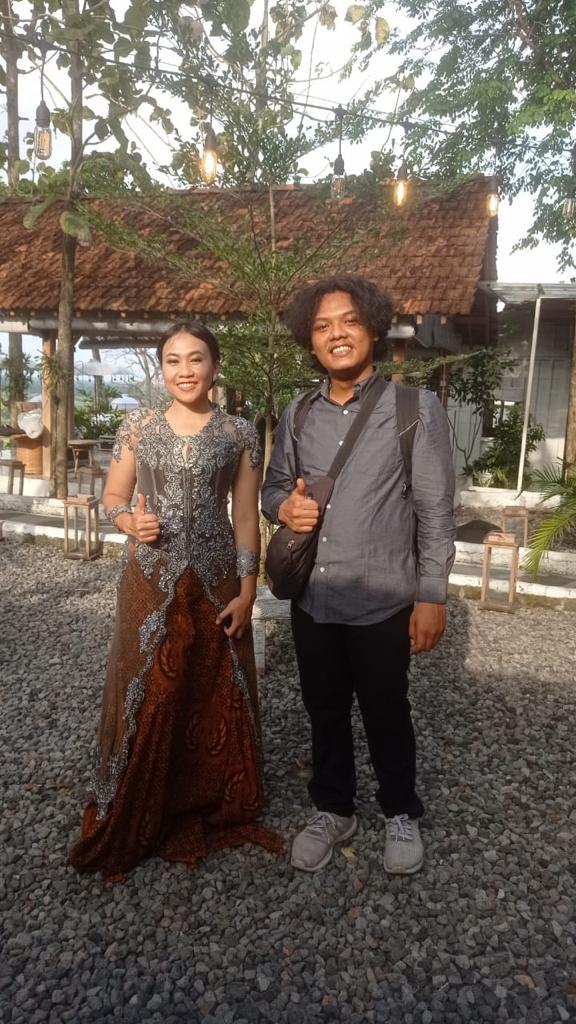 Peni Candrarini is one of the foremost composers and creative performers of contemporary gamelan music working in Indonesia today. She has an extensive track record as a singer, composer, songwriter, poet, and educationalist, and is Director of the Jagad Sentana Art foundation.
Rangga Purnama Aji is a composer, electronic musician, songwriter, live coder, video artist, digital artist, and the initiator of the Paguyuban Algorave Indonesia.
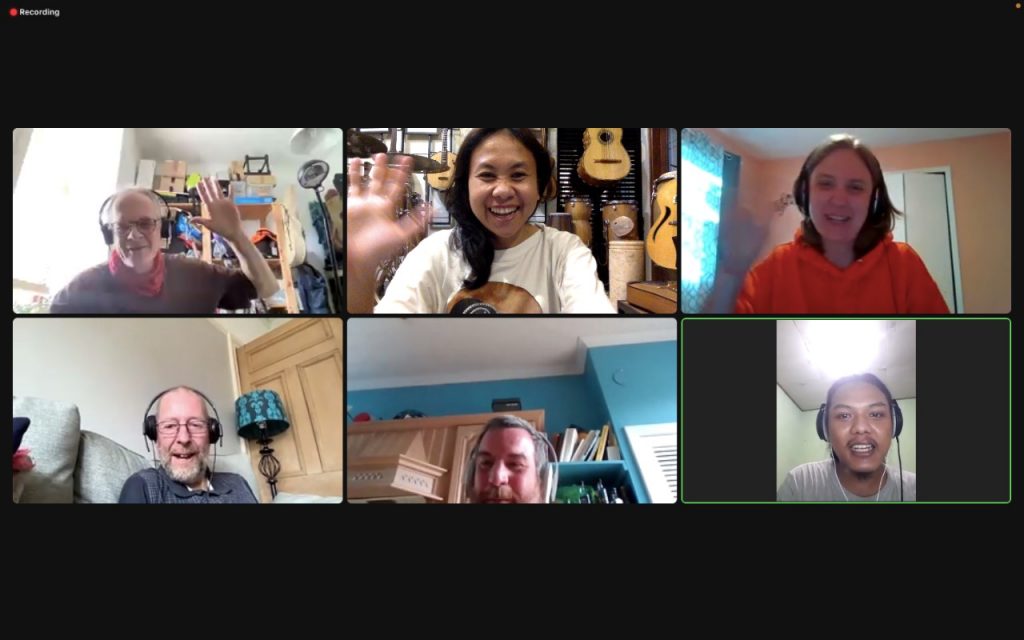
Gamelan Naga Mas, the Glasgow Gamelan Group, is a not-for-profit community group who are custodians of the ‘Spirit of Hope’ gamelan. As well as studying and performing traditional repertoire, they are also very active in creating new music for gamelan. The Naga Mas creative team for the Floating Gold project comprises J Simon van der Walt (composer), Katherine Waumsley (community musician), Heather Strohschein (ethnomusicologist), Sen Sewell (musician), and Bill Whitmer (scientist and musician).
Our aims
- to create original artistic work through the media of music, moving image, performance and text
- to foster international understanding through the arts and culture, in particular between Indonesia and Scotland
- to pioneer fresh approaches to musical collaboration in a post-travel world, including the use of new and emerging technologies